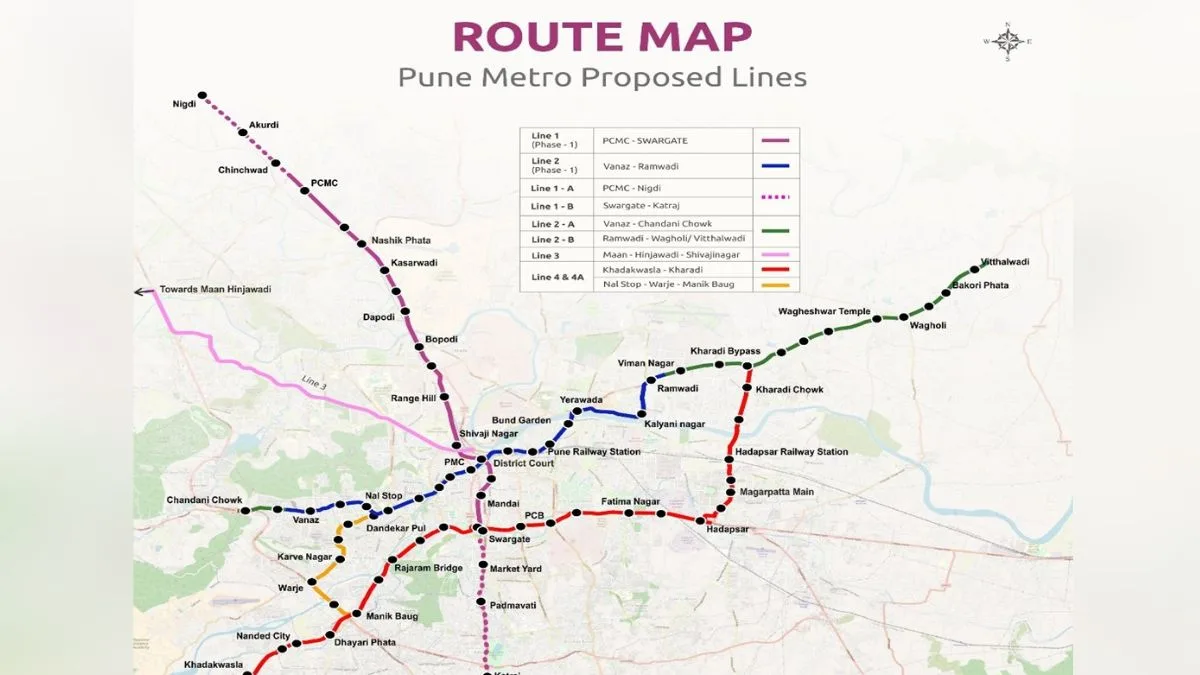
The Union Cabinet, on Wednesday, greenlit the construction of Line 4 (Kharadi–Hadapsar–Swargate–Khadakwasla) and Line 4A (Nal Stop–Warje–Manik Baug) as part of Phase-2 of the Pune Metro Rail Project, delivering a significant boost to urban mobility in India’s thriving city of Pune.
At a press briefing, Minister of Information and Broadcasting Ashwini Vaishnaw described the approval as a transformative step, highlighting that the two lines will cover a combined length of 31.636 kilometers with 28 elevated stations. “These corridors will connect key IT hubs, commercial centers, educational institutions, and residential areas in East, South, and West Pune,” Vaishnaw said.
Advertisement
The project, estimated to cost Rs 9,857.85 crore, will be funded jointly by the Central Government, the Government of Maharashtra, and external bilateral and multilateral agencies.
Integral to Pune’s Comprehensive Mobility Plan, Lines 4 and 4A will seamlessly integrate with existing and upcoming metro routes. Strategic interchanges at Kharadi Bypass, Nal Stop, Swargate, and Hadapsar Railway Station will enhance connectivity across metro, rail, and bus networks, easing commuter flow and congestion.
Traversing vital corridors such as Solapur Road, Magarpatta Road, Sinhagad Road, Karve Road, and the Mumbai–Bengaluru Highway, these new lines aim to promote sustainable and safe urban transport.
Ridership projections are optimistic, with daily passengers on Lines 4 and 4A expected to soar from 4.09 lakh in 2028 to over 11.7 lakh by 2058. The Kharadi–Khadakwasla stretch alone is projected to handle 9.33 lakh passengers daily at that time.
Maharashtra Metro Rail Corporation Limited (Maha-Metro) will oversee the project, which is already advancing with preliminary activities like topographical surveys and detailed design planning.
With this expansion, Pune Metro’s network will exceed 100 kilometers, marking a milestone in the city’s evolution toward a modern, efficient, and eco-friendly public transport system.
“These new corridors will save precious commuting time, reduce traffic snarls, and provide citizens with a reliable, affordable, and green travel option,” Vaishnaw added. “They will become the lifelines of Pune, reshaping urban mobility and driving the city’s growth for decades to come.”